
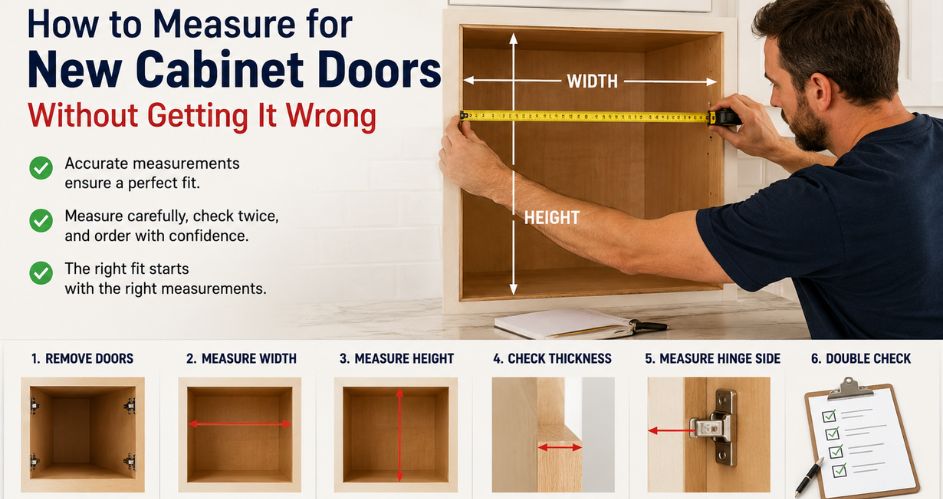
Replacing cabinet doors is one of the more satisfying home improvement projects you can take on. The impact is immediate, the process is manageable, and you do not need to tear apart your kitchen to get results that look like a full renovation.
But there is one step that determines whether the whole project goes smoothly or turns into a frustrating do-over: getting the measurements right before you order.
This is where most people run into problems. Not because measuring is complicated, but because cabinet doors have a few variables that are easy to overlook if you have not done this before.
Start With Your Overlay Type
Before you measure anything, you need to know what type of overlay your cabinets use. This tells you how much of the cabinet frame the door covers, and it directly affects the size you order.
Full overlay doors cover almost the entire face frame, leaving only a small gap between adjacent doors. This is the most common style in modern kitchens and gives cabinetry a clean, furniture-like appearance.
Standard overlay, sometimes called half overlay, covers half the style on each side. This is typical in older kitchens where cabinets were built with wider face frames.Inset doors sit flush inside the cabinet frame rather than overlapping it. This is the most precise configuration and requires the tightest measurements of the three.
If you are replacing existing doors, the easiest way to identify your overlay type is to look at how the current doors sit on the frame. That tells you exactly what you are working with.
How to Measure for New Cabinet Doors
Once you know your overlay type, measuring is straightforward. The goal is to determine the finished door size, which accounts for the opening plus whatever overlay applies.
For full overlay, measure the cabinet opening from inside edge to inside edge, both height and width. Then add your overlay on each side. A standard full overlay adds roughly half an inch per side on the width and half an inch per side on the height, but confirm the specific overlay your hinges support before finalizing.
For standard overlay, measure the opening and add a quarter inch per side on each edge. This gives you the overlap onto the face frame while leaving room for adjacent doors to close without hitting each other.
For inset, measure the opening precisely and subtract a small amount, typically an eighth of an inch per side, to allow clearance for the door to open and close without binding. Inset requires the most care because there is no overlay to compensate for minor sizing errors.
The team at Cabinet Doors walks through every configuration in detail in their guide on how to measure for new cabinet doors, which is worth reading before you place any order.
Measure Every Opening Individually
This is the step people skip and then regret. Even in kitchens that look perfectly uniform, individual cabinet openings often vary by an eighth or even a quarter inch. That variation comes from how the cabinets were installed, how the house has settled over time, and normal manufacturing tolerances in the original build.
If you order all your doors to one size based on a single measurement, some of them will not fit correctly. Measure each opening separately, record the dimensions per opening, and order accordingly. It takes more time upfront and saves a significant headache on install day.
A Few Other Things to Check
Write down measurements immediately rather than trying to hold them in your head. Use a metal tape measure rather than a fabric one for accuracy. Measure twice per opening before recording anything.
If you are ordering doors for both upper and lower cabinets, keep those measurements in separate lists so nothing gets mixed up when your order arrives.
Check your hinge boring requirements before finalizing the order. Most suppliers offer pre-drilled hinge holes, and getting that spec right means your new doors mount cleanly with your existing or new hinges.
Getting the measurements right is the whole job. Everything else, the style, the finish, the hardware, is straightforward once you have accurate numbers in hand.

