
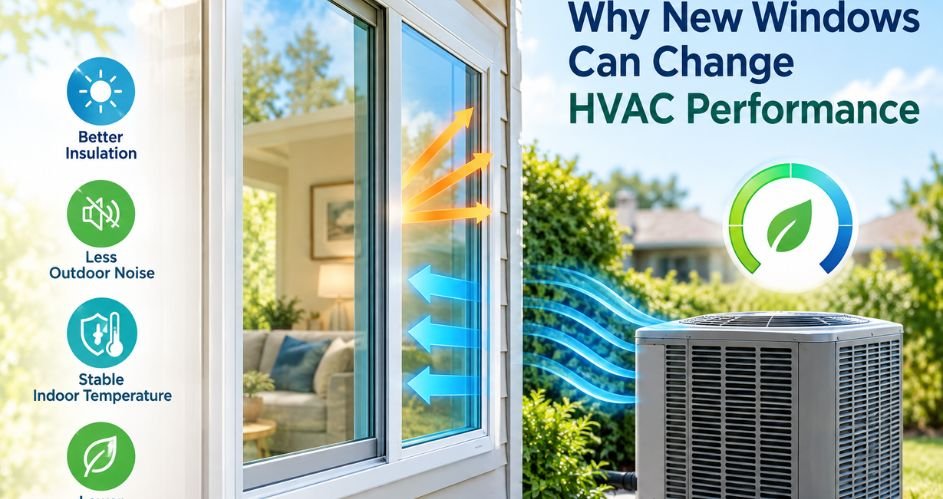
Replacing old windows can affect more than comfort and energy bills. By reducing heat gain, heat loss, and air leakage, new windows can change how hard your heating and cooling system needs to work. Understanding these changes can help homeowners evaluate HVAC performance, future HVAC installation needs, and overall indoor comfort after a window upgrade.
How Energy Efficient Windows Replacement Changes HVAC Needs
Energy efficient windows replacement can reduce the amount of outdoor heat entering a home in warm weather and slow the loss of indoor heat during colder weather. That lowers the heating and cooling load the HVAC system has to manage.
The impact can be especially noticeable in homes with older single-pane windows, deteriorated seals, metal frames with poor thermal performance, or significant air leakage around the window openings. In summer, lower solar heat gain can reduce afternoon temperature spikes in rooms with heavy sun exposure. In winter, better-insulated glass and frames help interior surfaces stay warmer, which reduces heat loss and can improve comfort near windows.
The effect is often uneven throughout the house. A west-facing room with several large windows may experience a larger change than a shaded room with little glass. Temperature differences between sunny, shaded, upstairs, and downstairs spaces may become less pronounced. That means window replacement can alter room-by-room demand, not just the home’s total energy use.
This matters for HVAC operation because the system may no longer need to deliver the same amount of conditioned air to every area that previously required it. In some homes, window replacement can expose existing airflow or balancing issues that were previously masked by high window-related loads.
The size of the change depends on the home’s climate, window area and orientation, existing insulation and air sealing, the performance ratings of the new windows, and the quality of the installation. Window replacement affects one part of the home’s total heating and cooling load, so the results should be considered alongside the roof, walls, ductwork, insulation, air leakage, and HVAC equipment.
Do New Windows Lower Energy Bills
New windows can lower energy bills when they reduce heat transfer, solar heat gain, and unwanted air leakage enough to decrease HVAC energy use. The actual savings vary significantly from one home to another, so energy savings with new windows depend heavily on the home’s existing conditions.
The biggest factors include the condition of the windows being replaced, local weather, utility rates, the number and size of the windows, which directions they face, shading from trees or overhangs, glass performance, frame construction, HVAC installation quality, thermostat settings, and the efficiency of the existing HVAC system.
A homeowner replacing leaky single-pane windows may see a more meaningful change than someone replacing relatively modern double-pane units. The largest savings potential usually occurs when old windows are single-pane, poorly sealed, deteriorated, or exposed to strong sun. Savings may be smaller when the existing windows are already insulated and reasonably airtight.
Window orientation also matters. Homes with large west- or south-facing glass areas can respond differently because solar exposure can account for a substantial portion of the cooling load. Replacing a large west-facing window can have a different cooling impact than replacing the same window on the north side of the house.
For a realistic estimate of new windows energy savings, homeowners should look beyond a general savings percentage. Comparing the old and new windows’ U-factor, solar heat gain coefficient, air-leakage performance, and local energy costs gives a more useful picture of how the replacement may affect the specific home.
Benefits Of Energy Efficient Replacement Windows
Energy efficient replacement windows can help an HVAC system maintain indoor conditions with less interference from heat transfer and air leakage at the building envelope.
Common benefits include more stable room temperatures, fewer hot or cold areas near windows, reduced radiant heat from sun-exposed glass, less cold-window discomfort during winter, lower peak heating and cooling demand, and potentially shorter HVAC runtime.
Improved windows can also help the thermostat better represent conditions throughout the house. In a home with poor-performing windows, the thermostat may be satisfied while rooms with heavy sun exposure or drafty glass remain uncomfortable. Reducing those localized loads can make the entire house easier to condition evenly.
One important change is interior surface temperature. In winter, better-performing glass tends to stay warmer on the indoor side, which can reduce the cold radiant sensation people feel when sitting near a window.
In summer, glass with lower solar heat gain can reduce the intense radiant warmth associated with direct sun. That can make rooms feel more comfortable even when the thermostat setting remains unchanged.
There can be secondary benefits as well. Interior furnishings may receive better protection from ultraviolet exposure when appropriate glazing is used, and interior glass surfaces may remain warmer during cold weather, which can reduce the likelihood of condensation under certain indoor conditions.
How Energy Efficient Windows Reduce Heat Gain And Loss
Energy efficient windows control several paths of heat transfer.
Insulated glass units use two or more panes separated by a sealed space, often filled with an insulating gas such as argon. This construction slows conductive heat transfer through the glass.
Low-emissivity, or low-E, coatings manage radiant heat by reflecting selected wavelengths of infrared energy while still allowing useful visible light through. Frames with better thermal resistance reduce heat movement around the edges of the glass.
During summer, glazing with an appropriate solar heat gain coefficient can limit the amount of solar energy entering the home, particularly through windows with strong sun exposure. That reduces the cooling load created by direct sunlight.
During winter, insulated glazing, low-E coatings, thermally improved frames, and properly sealed installation help retain indoor heat and keep interior glass surfaces warmer. Lower U-factor performance helps reduce heat escaping through the window assembly.
Air sealing also matters. Weatherstripping and well-sealed window openings reduce uncontrolled air movement around the window. Heat can bypass even good glass if outdoor air leaks around the frame, sash, or rough opening.
The overall performance comes from the complete window assembly, including the glass, spacers, frame, sash, seals, and installation details. For this reason, energy efficient windows replacement should be evaluated as both a product and an installation project.
How Energy Savings With New Windows Affect HVAC Runtime
When new windows reduce the home’s heating or cooling load, the HVAC system may need less runtime to maintain the thermostat setting. During peak weather, that can mean fewer total operating hours and less energy consumption. These energy savings with new windows may be most noticeable when the old windows allowed substantial heat transfer or air leakage.
Window improvements can also influence cycling behavior. A system serving a home with high solar gain or substantial window leakage may start frequently as indoor temperatures change. Reducing those load swings can create steadier operating conditions.
Proper cycling still depends heavily on equipment sizing. An oversized air conditioner may continue to run short cycles even after efficient windows are installed, and reducing the cooling load can make oversizing more noticeable. The equipment may reach the thermostat setting quickly and shut off before completing a longer cycle.
This is particularly important with air conditioning because cooling equipment also removes moisture. Shorter cycles can reduce dehumidification time, which may lead to comfortable temperature readings but higher indoor humidity.
The most useful post-upgrade indicators are not just total runtime. Cycle length, humidity levels, room temperatures, and how the system behaves during the hottest or coldest parts of the day can reveal more about the effect of the window replacement.
Can New Windows Energy Savings Affect HVAC Sizing?
Replacing inefficient windows can lower a home’s heating and cooling load enough to change how the existing HVAC equipment compares with the home’s actual needs. In some cases, new windows energy savings can therefore affect how equipment sizing is evaluated.
HVAC systems are ideally sized using a load calculation that accounts for window area, orientation, glass performance, insulation, air leakage, occupancy, climate, and other building characteristics. If older windows contributed heavily to the original load, installing higher-performing replacements can reduce the amount of heating or cooling capacity the home requires.
A system that was properly sized for older, inefficient windows may become somewhat oversized after major envelope improvements. The impact depends on how much window area was replaced and how poor the original windows were.
The existing system does not automatically need to be replaced after a window project. Many existing systems will continue to operate acceptably. Its performance should be observed.
The issue becomes more important when the equipment is nearing replacement. The new HVAC system should be sized using the updated window specifications rather than the home’s previous energy characteristics. Otherwise, a contractor may select equipment based on a load that no longer exists.
How Energy Efficient Windows And Installation Affect HVAC Performance
Every major part of a window affects how much heating and cooling demand it places on the home.
The glass package influences insulation and solar heat gain. Important specifications include U-factor, which reflects heat transfer through the window, and solar heat gain coefficient, which indicates how much solar energy passes through the glazing. Low-E coating type and placement can also be selected for the climate and window orientation.
The frame matters because heat can travel through framing materials as well as glass. Vinyl, fiberglass, wood, composite, and thermally improved metal frames have different thermal characteristics. Some frames conduct heat more readily than others, while insulated or thermally improved frames can reduce edge losses.
Window style can affect air leakage. Fixed windows typically have fewer moving joints, while operable windows depend on sash alignment, seals, locking hardware, and weatherstripping.
Installation is equally important. A high-performance window installed with gaps, poor flashing, incomplete insulation around the rough opening, or inadequate air sealing may not deliver its rated performance in the home. Installation can outweigh product ratings in the real world, which is why energy efficient windows replacement depends on workmanship as well as window specifications.
The HVAC system responds to the installed window assembly, not simply the specifications printed on the product label.
Can Energy Efficient Windows Replacement Affect Humidity?
They can change the home’s ventilation and moisture behavior, particularly when old windows were allowing substantial uncontrolled air leakage.
Older, drafty homes often receive some incidental outdoor air through gaps around windows, doors, and other parts of the structure. Replacing those windows with tighter units can reduce that uncontrolled airflow.
This generally improves energy performance, though it also means indoor moisture, odors, cooking pollutants, and other contaminants may remain inside longer if the home lacks adequate ventilation.
In humid climates, reduced air leakage can be beneficial because less warm, moisture-laden outdoor air enters the house. Indoor humidity can still become elevated when an air conditioner is oversized, bathroom or kitchen exhaust is inadequate, ductwork has moisture problems, or the home has other sources of water vapor.
In tighter homes, kitchen exhaust, bathroom ventilation, HVAC dehumidification, and overall fresh-air strategy become more important. The goal is controlled ventilation rather than relying on random leakage through the building envelope.
After significant air-sealing improvements, homeowners should pay attention to indoor relative humidity, exhaust ventilation, HVAC runtime, and signs of condensation or persistent moisture. In very tight homes, a qualified HVAC professional can determine whether mechanical ventilation should be evaluated.
When To Reassess HVAC After New Windows Energy Savings
HVAC performance is worth reassessing whenever a window replacement substantially changes the home’s thermal envelope, especially when many older or inefficient windows are replaced at once. This is one way to determine whether new windows energy savings are also changing system operation.
Homeowners should pay particular attention during the first periods of very hot or cold weather after the project. Useful signs include shorter equipment runtime, noticeably different cycling patterns, improved or worsened humidity control, changes in room-to-room temperature balance, recovery time, peak-hour comfort, and whether the system reaches the thermostat setting unusually quickly.
Reassessment is also appropriate when the existing HVAC system already has comfort problems, when extensive insulation or air-sealing work was completed alongside the windows, or when equipment capacity was originally selected using outdated rules of thumb.
A formal HVAC load calculation is especially useful when the homeowner is also planning to replace the heating or cooling equipment. The contractor should use the specifications of the new windows rather than relying on assumptions about the old ones, including the new window U-factor, solar heat gain coefficient, size, and orientation.
A current load calculation provides a better basis for selecting future equipment capacity and evaluating how the home now performs as a complete system. It can also help connect energy savings with new windows to future HVAC decisions.

